
STAIRLIFTS GRANTS & FUNDING
Help with the cost of a stairlift in Merseyside
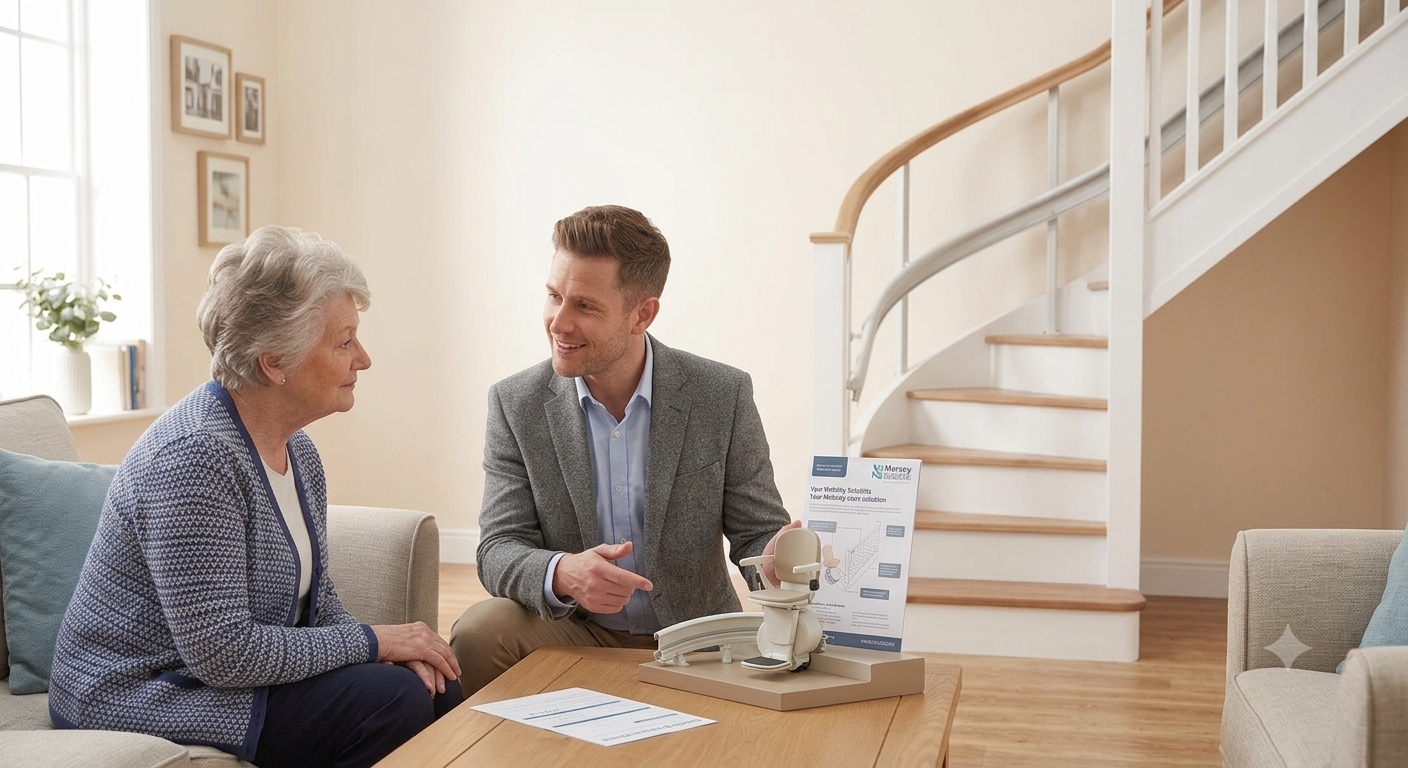
A stairlift is a significant purchase - but you may not have to pay the full price yourself. Between the Disabled Facilities Grant, VAT relief and charitable funds, there are several routes to help. Here's how each one works, in plain English, and how to start.
Maximum Disabled Facilities Grant in England
£30,000
VAT if you're disabled or over 60 (vs 20%)
0%–5%
Council occupational-therapy assessment
Free
The main government scheme
The Disabled Facilities Grant (DFG)
The Disabled Facilities Grant is the main route to public funding for a stairlift in the UK. It's a government grant paid through your local council to help adapt your home so a disabled person can live there safely and independently. A stairlift is one of the most common things it pays for.
The grant can cover the stairlift itself, the installation, any electrical work, and other adaptations needed to fit it safely - as long as an occupational therapist assesses it as necessary and appropriate, and the council agrees it's reasonable and practical for your home.
How much you can get depends on where you live in the UK:
| Nation | Maximum grant | How it's run |
|---|---|---|
| England | Up to £30,000 | Through your local council |
| Wales | Up to £36,000 | Council; Care & Repair Cymru can help |
| Northern Ireland | Up to £25,000 | Through the Housing Executive |
| Scotland | Varies (min. 80% mandatory) | Scheme of Assistance, via council |
Since you're in Merseyside, the England figure applies - up to £30,000 per application. In practice a stairlift costs a small fraction of that ceiling, so the cap is rarely the issue; the means test usually matters more (see below).
Who can apply?
You can apply whether you own your home or rent it (tenants usually need the landlord's permission). The disabled person must intend to live in the property throughout the grant period - normally five years. There's no need to be formally "registered disabled"; what matters is the occupational therapist's assessment of need.
Important: don't start the work first
This catches people out. If you order or install a stairlift before the council formally approves your grant, you can lose the funding entirely. Always wait for written approval - or written permission to proceed at your own risk - before anything is fitted. We'll never pressure you to commit while a grant is in progress.
What you'll actually pay
Means testing & your contribution
For most adult applicants in England, the DFG is means tested. Importantly, the means test decides how much you contribute - not whether you qualify. Even if you're asked to pay something, the grant still reduces what comes out of your pocket.
- Children under 18 are exempt - applications for children are not means tested at all.
- On certain benefits, you automatically pass - including Income Support, income-based Jobseeker's Allowance, income-related ESA, Pension Credit (guarantee) and Universal Credit.
- Savings over £6,000 are typically taken into account; savings below that usually aren't.
- Some disability benefits are ignored - for example, councils generally don't count Attendance Allowance or Disability Living Allowance as income for this test.
If you pass the means test with a zero contribution, the grant can cover the full cost of a stairlift. If not, it covers part, and you make up the difference - which is exactly where VAT relief and charitable funds can help close the gap.
From first call to fitted
How to apply for a stairlift grant
The process runs through your council and is built around a free assessment. It does take time - often weeks to a few months - so it's worth starting early rather than waiting for a crisis.
Contact your council's adaptations team
Ask for a care needs (occupational therapy) assessment. It's free, and you're entitled to one regardless of income or savings. Links to each Merseyside council are just below.
Occupational therapist visits
An OT assesses how you move around your home and recommends what's needed. Their report is the key document - if a stairlift is right for you, make sure it's clearly recommended.
Council carries out the means test
They confirm the grant amount and any contribution. Children and people on certain benefits skip or pass this automatically.
Get quotes for the work
You'll usually be asked for one or more quotes. We're happy to provide a clear written quote for a council grant application - just ask.
Approval, then installation
Once the council approves in writing, the work can go ahead. Never start before approval, or you risk losing the grant.
A quick way to check eligibility yourself
The national body Foundations runs a free self-assessment tool called "Adapt My Home", and Age UK has clear, independent guidance. Both are good starting points before you contact the council.
Where to start locally
Your Merseyside council's adaptations team
The Disabled Facilities Grant is applied for through your own borough council. Here's the right starting point for each of the five Merseyside boroughs:
A local note
Some Merseyside councils deliver adaptations with a housing partner - for example, Sefton's Home Improvement Service and Knowsley's care & repair arrangements. If you rent from a housing association, they may carry out or contribute to the work themselves, but you can still apply for a DFG and should be treated like any other applicant.
Often overlooked - and easy to claim
VAT relief on stairlifts
Whether or not you get a grant, you may not have to pay VAT on your stairlift. Under HMRC rules (VAT Notice 701/7), stairlifts supplied and installed in a private home can be zero-rated or reduced-rated for eligible customers - a real saving against the standard 20%.
| Your situation | VAT rate | What it applies to |
|---|---|---|
| Chronically sick or disabled | 0% | Supply, installation, and later repairs/servicing |
| Aged 60+ (not disabled) | 5% | The original supply and installation only |
| Neither of the above | 20% | Standard rate applies |
"Chronically sick or disabled" is defined broadly - it covers a physical or mental impairment with a long-term, substantial effect on everyday activities, or a condition treated as a chronic sickness (such as arthritis, Parkinson's, MS, heart disease or diabetes). It does not include someone who is simply elderly and able-bodied, or only temporarily injured.
How you claim it
There's no need for medical proof or a doctor's letter. You simply sign a short declaration confirming you meet the conditions, which we provide, and we apply the relief to your invoice. It's important to claim before you pay - VAT can't be refunded afterwards. A family member or carer can sign on the person's behalf.
If you're over 60 and also disabled or chronically sick, claim the 0% rate - it covers more.
VAT relief and a DFG work together: the grant covers what you actually pay, and removing the VAT lowers that figure - so relief effectively stretches your grant further.
If there's still a gap
Charity & other funding
If a grant doesn't cover everything, or you don't qualify, charitable funds can sometimes help bridge the difference. These are usually supplementary rather than a full solution, and each has its own rules:
- Turn2us - a free grants-search tool where you enter your details to find charitable funds you may be eligible for. A good first stop.
- Independence at Home - grants towards equipment; applications must come through a health or social care professional, not directly.
- Benevolent funds - many former trades, professions, regiments and unions have funds for former members. Worth checking if this applies to you or a relative.
- Check your benefits first - non-means-tested benefits like Attendance Allowance or PIP can free up money for equipment. Age UK's benefits calculator is a quick way to check.
A note on "free stairlift" claims
You may see adverts promising a "free stairlift". Be a little cautious: there's no universal entitlement to a free stairlift, and the NHS doesn't directly pay for one. What's true is that if you pass the DFG means test with a zero contribution, the grant can cover the full cost. We'd always rather explain this honestly than over-promise.
Common questions
Stairlift funding - FAQs
Can I get a stairlift for free?
Does the NHS pay for a stairlift?
How long does a Disabled Facilities Grant take?
Do I have to pay VAT on a stairlift?
Can I apply for a grant if I rent my home?
Will a grant cover a curved stairlift?
We'll help you navigate the funding
We can provide a clear written quote for your council application, apply VAT relief where you're eligible, and never pressure you while a grant is in progress. Honest help, start to finish.